Our Watershed Explorers Experiences are single day sessions which engage students in a variety of watershed restoration and health themes. These single day student experiences are built to provide hands-on lessons for students to form a deeper connection to the Anacostia Watershed.
For school visit sessions AWS educators will visit your school to work with your students. We can visit more than one class period and spend up to one full day at your school
Field experiences will take place at one of our programming locations-Bladensburg Waterfront Park, Anacostia park, or Kingman/Heritage Islands; with most trips occurring at Bladensburg Waterfront Park. These programs are free of charge with donations accepted.
Educators can choose from our menu of school based classes or field sessions. *Recommended levels can be modified for other ages/class levels.
Watershed Explorers- School Visits
PROGRAM: Watershed Stewards Class Visit
- Watershed Demonstration
- School yard trash clean up and evaluation
Students gain an understanding of what a watershed is and pollution impacts within the Anacostia Watershed. Students participate in hands-on activities to protect their watershed and the Anacostia River.
- Recommended Level: 1st-12th
- Time of Year: Sept-June
National Standards Alignment Examples:
- 3-LS4-4: Make a claim about the merit of a solution to a problem caused when the environment changes and the types of plants and animals that live there may change
- 4-ESS3-2: Generate and compare multiple solutions to reduce the impacts of natural Earth processes on humans
- 5-ESS3-1: Obtain and combine information about ways individual communities use science ideas to protect the Earth’s resources and environment.
- MS-LS2-4: Construct an argument supported by empirical evidence that changes to physical or biological components of an ecosystem affect populations.
PROGRAM: Solutions to Pollution
- Build a trash trap model
Students learn about pollution issues in the Anacostia Watershed and local solutions to those issues. Students explore how community action, plants, education, and engineered solutions are helping the Anacostia River
- Recommended Level: 6th-12th
- Time of Year: Sept-June
National Standards Alignment Examples:
- MS-LS2-4: Construct an argument supported by empirical evidence that changes to physical or biological components of an ecosystem affect populations.
- HS-LS2-2: Use mathematical representations to support and revise explanations based on evidence about factors affecting biodiversity and populations in ecosystems of different scales.
PROGRAM: River Scientists Class Visit
- Anacostia River water quality testing
- Create a river report card
Students learn about what makes a river healthy and participate in hands-on water quality testing in the classroom. Students will measure: temperature, pH, dissolved oxygen, nitrates, phosphates, and turbidity
- Recommended Level: 4th-12th
- Time of Year: Sept-June
National Standards Alignment Examples:
- 5-ESS3-1: Obtain and combine information about ways individual communities use science ideas to protect the Earth’s resources and environment.
- MS-LS2-4: Construct an argument supported by empirical evidence that changes to physical or biological components of an ecosystem affect populations.
- HS-LS2-2: Use mathematical representations to support and revise explanations based on evidence about factors affecting biodiversity and populations in ecosystems of different scales.
PROGRAM: Wildlife of the Watershed Class Visit
(3 hours, with half an hour to eat your packed lunch)
- Wildlife food web activity
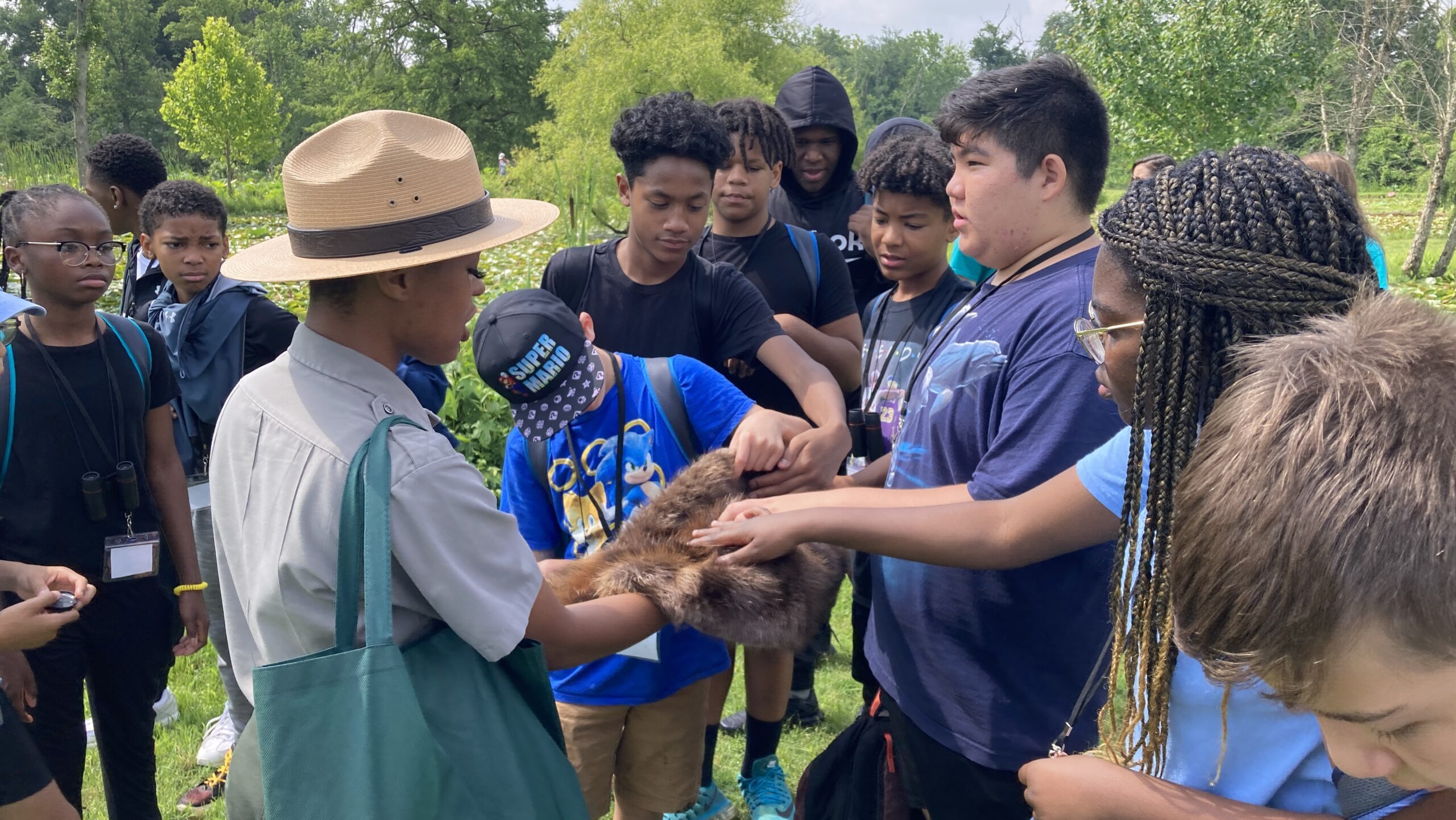
- Wildlife pelts, skulls, and tracks exploration
- School yard animal signs scavenger hunt
Students will study specimens such as animal furs, replica skulls, and tracks of local wildlife. Students explore how we can use signs of animals to know what lives nearby. The group will also explore how these animals interact with a food web activity.
- Recommended Level: 1st-5th
- Time of Year: Sept-June
National Standards Alignment Examples:
- 1-LS1-1: Use materials to design a solution to a human problem by mimicking how plants and/or animals use their external parts to help them survive, grow, and meet their needs.
- 3-LS4-4: Make a claim about the merit of a solution to a problem caused when the environment changes and the types of plants and animals that live there may change..
- 5-ESS3-1: Obtain and combine information about ways individual communities use science ideas to protect the Earth’s resources and environment.
PROGRAM: Mussel Power Class Visit
Hands-on mussel measuring activity
Mussel data collection
Students learn about how freshwater mussels are helping to clean the river! Students hold and measure live freshwater mussels.
- Recommended Level: 1st-12th
- Time of Year: Sept-June
National Standards Alignment Examples:
- 1-LS1-1: Use materials to design a solution to a human problem by mimicking how plants and/or animals use their external parts to help them survive, grow, and meet their needs.
- 3-LS4-3 Biological Evolution: Unity and Diversity
- Construct an argument with evidence that in a particular habitat some organisms can survive well, some survive less well, and some cannot survive at all.
- MS-LS2-4: Construct an argument supported by empirical evidence that changes to physical or biological components of an ecosystem affect populations.
- HS-LS2-2: Use mathematical representations to support and revise explanations based on evidence about factors affecting biodiversity and populations in ecosystems of different scales.
Watershed Explorers- Field Trips
PROGRAM: Watershed Stewards Field Trip
(3 hours, with half an hour to eat your packed lunch)
- Boat tour of the Anacostia River
- Community trash clean up
Students gain an understanding of what a watershed is and the histories and impacts in their Anacostia Watershed. Students participate in hands-on activities to protect their watershed and the Anacostia River.
- Recommended Level: 1st-12th
- Time of Year: Sept-Nov and April-June
National Standards Alignment Examples:
- 3-LS4-4: Make a claim about the merit of a solution to a problem caused when the environment changes and the types of plants and animals that live there may change
- 4-ESS3-2: Generate and compare multiple solutions to reduce the impacts of natural Earth processes on humans
- 5-ESS3-1: Obtain and combine information about ways individual communities use science ideas to protect the Earth’s resources and environment.
- MS-LS2-4: Construct an argument supported by empirical evidence that changes to physical or biological components of an ecosystem affect populations.
PROGRAM: Wetland Wonders Field Trip
(3 hours, with half an hour to eat your packed lunch)
- Boat tour of the Anacostia River
- Wild Rice seed planting/mud balling
Students learn what makes wetlands an important part of our watershed, what plants and animals live in wetlands and explore wetlands found along the river. Students participate in a hands-on wetland restoration activity.
- Recommended Level: 1st-12th
- Time of Year: Sept-Nov and April-June
National Standards Alignment Examples:
- 1-LS1-1: Use materials to design a solution to a human problem by mimicking how plants and/or animals use their external parts to help them survive, grow, and meet their needs.
- 2-ESS2-1: Compare multiple solutions designed to slow or prevent wind or water from changing the shape of the land.
- MS-LS2-4: Construct an argument supported by empirical evidence that changes to physical or biological components of an ecosystem affect populations.
- HS-LS2-2: Use mathematical representations to support and revise explanations based on evidence about factors affecting biodiversity and populations in ecosystems of different scales.
PROGRAM: River Explorers Canoe Trip
(3 hours, with half an hour to eat your packed lunch)
- Canoe Tour on the Anacostia River
This immersive experience allows students to explore the Anacostia River on a two hour canoe tour. Students will paddle down the main step of the river and enter wetlands along the river.
*Max group size 15 people including adults
- Recommended Level: 6th-12th
- Time of Year: Sept-Nov and April-June
National Standards Alignment Examples:
- MS-LS2-4: Construct an argument supported by empirical evidence that changes to physical or biological components of an ecosystem affect populations.
- HS-LS2-2: Use mathematical representations to support and revise explanations based on evidence about factors affecting biodiversity and populations in ecosystems of different scales.
PROGRAM: River Scientists Field Trip
(3 hours, with half an hour to eat your packed lunch)
- Boat tour on the Anacostia River
- Anacostia River water quality testing
Students learn about what makes a river healthy and participate in hands-on water quality testing as well as a boat tour along the river.
- Recommended Level: 6th-12th
- Time of Year: Sept-Nov and April-June
National Standards Alignment Examples:
- MS-LS2-4: Construct an argument supported by empirical evidence that changes to physical or biological components of an ecosystem affect populations.
- HS-LS2-2: Use mathematical representations to support and revise explanations based on evidence about factors affecting biodiversity and populations in ecosystems of different scales.
PROGRAM: Wildlife of the Watershed Field Tripld Trip
(3 hours, with half an hour to eat your packed lunch)
- Wildlife focused boat tour on the Anacostia River
- Wildlife pelts, skulls, and tracks exploration
Students explore the river by boat and learn about all the animals they see along the river. Students will also study specimens such as animal furs, replica skulls, and tracks.
- Recommended Level: 1st-5th
- Time of Year: Sept-Nov and April-June
National Standards Alignment Examples:
- 1-LS1-1: Use materials to design a solution to a human problem by mimicking how plants and/or animals use their external parts to help them survive, grow, and meet their needs.
- 3-LS4-4: Make a claim about the merit of a solution to a problem caused when the environment changes and the types of plants and animals that live there may change.
- 5-ESS3-1: Obtain and combine information about ways individual communities use science ideas to protect the Earth’s resources and environment.
PROGRAM: Mussel Power Field Trip
(3 hours, with half an hour to eat your packed lunch)
- Boat tour on the Anacostia River
- Hands-on mussel measuring activity
Students explore the Anacostia River on a boat tour and learn about how freshwater mussels are helping to clean the river! Students hold and measure live freshwater mussels.
- Recommended Level: 1st-12th
- Time of Year: Sept-Nov and April-June
National Standards Alignment Examples:
- 1-LS1-1: Use materials to design a solution to a human problem by mimicking how plants and/or animals use their external parts to help them survive, grow, and meet their needs.
- 3-LS4-3 Biological Evolution: Unity and Diversity
- Construct an argument with evidence that in a particular habitat some organisms can survive well, some survive less well, and some cannot survive at all.
- MS-LS2-4: Construct an argument supported by empirical evidence that changes to physical or biological components of an ecosystem affect populations.
- HS-LS2-2: Use mathematical representations to support and revise explanations based on evidence about factors affecting biodiversity and populations in ecosystems of different scales.